
Welcome to the Gene Scene! Each week, we will explore a gene from the ACMG Secondary Findings list—genes identified by the American College of Medical Genetics and Genomics as having clear, actionable health implications. These genes are included because they’re linked to serious but preventable or manageable conditions when identified early. Here, we focus on the condition that led to the gene’s inclusion on the list, providing clear, relevant information that supports your clinic. To subscribe to the Gene Scene, contact your local GSL or send a request to info@ambrygen.com.
To access the Gene Scene archives, visit our blog.
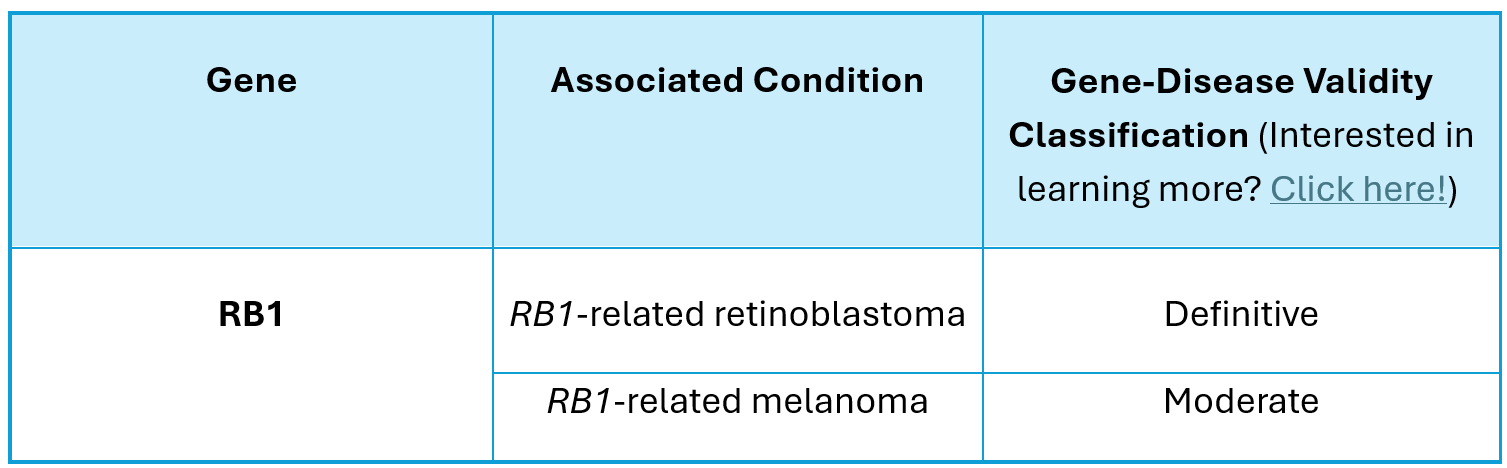
Clinical Phenotype Summary:
The RB1 gene (NM_000321.2) is located on chromosome 13q14.2, encodes the retinoblastoma-associated protein, and contains 27 coding exons. Pathogenic variants in this gene are known to cause RB1-related hereditary retinoblastoma, which is inherited in an autosomal dominant fashion.
RB1-related hereditary retinoblastoma confers an increased risk for:
• Retinoblastoma: Approximately 90% cumulative lifetime risk, typically presenting prior to age 5.
• Second primary malignancies: Increased risk for osteosarcoma, soft tissue sarcomas, and melanoma during adolescence and adulthood.
Clinical presentation and risks are characterized by:
• Early childhood onset of eye tumors (bilateral, unilateral, or trilateral).
• Potential for adult-onset malignancies even in the absence of a prior childhood retinoblastoma diagnosis.
• Variable expressivity influenced by the specific mutation and inheritance pattern.
The average age of onset for retinoblastoma is early childhood, often involving multiple or bilateral tumors, though unilateral or trilateral (involving the pineal gland) cases occur.
Loss of function has been reported as the mechanism of disease for RB1-related hereditary retinoblastoma.
Unique Considerations:
The penetrance of RB1 pathogenic variants is generally high, though a subset (less than 10%) of variants are moderately penetrant, resulting in lower and variable risk. Additionally, a parent-of-origin effect has been observed, with higher penetrance reported when the variant is inherited paternally. Cancer risks and the development of secondary malignancies also vary based on the laterality of the initial tumor, family history, and prior treatment course.
Clinical Resources:
Understanding Your Positive RB1 Genetic Test Result
Citations:
• Alekseeva EA, et al. (2021) Cancers (Basel) 13(20). (PMID: 34680218)
• Meel R, et al. (2020) Ocul Oncol Pathol 6(6):395-404. (PMID: 33447589)
• Imbert-Bouteille M, et al. (2019) Mol Genet Genomic Med 7(12):e913. (PMID: 31568710)
• Lohmann DR, Gallie BL. GeneReviews®. 2000 July 18 [Updated 2023 September 21]. (PMID: 20301625)
• Figueiredo D, et al. (2023) Cancers (Basel) 15(22). (PMID: 38001596)
• Schonfeld SJ, et al. (2021) Br J Cancer 124(7):1312-1319. (PMID: 33473166)
• Abramson DH, et al. (1998) J Pediatr 132(3):505-8. (PMID: 9544909)
• Eloy P, et al. (2016) PLoS Genet 12(2):e1005888. (PMID: 26925970)
• Imperatore V, et al. (2018) Eur J Hum Genet 26(7):1026-1037. (PMID: 29662154)
• Wong JR, et al. (2014) J Clin Oncol 32(29):3284-90. (PMID: 25185089)
• Kleinerman RA, et al. (2012) J Clin Oncol 30(9):950-7. (PMID: 22355046)
• Valverde JR, et al. (2005) BMC Genet 6:53. (PMID: 16269091)
• Harbour JW. (2001) Arch Ophthalmol 119(11):1699-704. (PMID: 11709023)
• Lohmann DR, et al. (1996) Am J Hum Genet 58(5):940-9. (PMID: 8651278)
• Plowman PN, et al. (2004) Clin Oncol (R Coll Radiol) 16(4):244-7. (PMID: 15214647)
Ambry Genetics Gene-Disease Validity Scheme
Each week, we explore a gene from the ACMG Secondary Findings list—genes identified by the American College of Medical Genetics and Genomics as having clear, actionable health implications. These genes are included because they’re linked to serious but preventable or manageable conditions when identified early.
To learn more about the ACMG Secondary Findings list, click here.
To read all previous Gene Scene emails, click here.