
Welcome to the Gene Scene! Each week, we will explore a gene from the ACMG Secondary Findings list—genes identified by the American College of Medical Genetics and Genomics as having clear, actionable health implications. These genes are included because they’re linked to serious but preventable or manageable conditions when identified early. Here, we focus on the condition that led to the gene’s inclusion on the list, providing clear, relevant information that supports your clinic. To subscribe to the Gene Scene, contact your local GSL or send a request to info@ambrygen.com.
To access the Gene Scene archives, visit our blog.
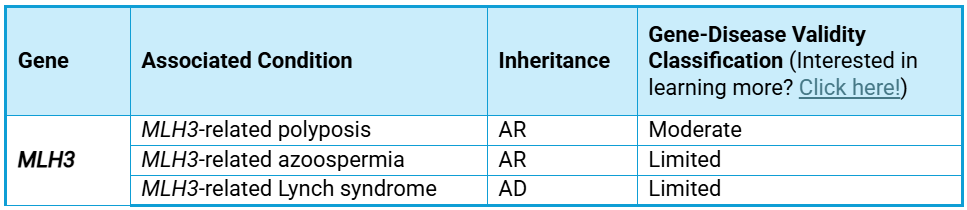
GENE SCENE SPOTLIGHT: This gene is not on the ACMG Secondary Findings List, however Ambry is dedicated to the search for new, evidence-backed insights that can meaningfully impact patient care. Our latest findings include additional evidence for MLH3, which has resulted in an upgraded gene-disease validity (GDV) for autosomal recessive polyposis and colorectal cancer predisposition.
Clinical Phenotype Summary:
The MLH3 gene (NM_001040108.1) is located on chromosome 14q24.3, contains 12 coding exons, and encodes the DNA mismatch repair protein Mlh3. Pathogenic variants in this gene are known to cause MLH3-related polyposis, which is inherited in an autosomal recessive fashion. Biallelic pathogenic variants in MLH3 confer a significantly increased risk for gastrointestinal adenomatous polyposis and colorectal cancer (CRC).
MLH3-related polyposis is characterized by:
- A significantly increased risk for gastrointestinal adenomatous polyposis and CRC
Penetrance in MLH3-related polyposis is incomplete, and variable expressivity is observed; therefore, cancer risks will differ based on individual and family history.
Heterozygous pathogenic variants in MLH3 have been reported in individuals with colorectal cancer; however, current evidence is insufficient to support an increased risk of cancer over that of the general population. Biallelic loss of function has been reported as the mechanism of disease for MLH3-related polyposis.
Unique Considerations:
Due to the extreme rarity of MLH3-related polyposis, accumulating enough published cases to characterize this gene required more than a decade. Multiple individuals harboring biallelic loss-of-function MLH3 variants have been reported with colorectal adenomas and cancer, a phenotype further supported by functional studies showing that MLH3 knockout mice develop gastrointestinal tumors. Ambry's internal data corroborated these findings, supporting our decision to upgrade the gene to moderate GDV.
MLH3 is considered a moderate-evidence gene for autosomal recessive colorectal polyposis/cancer, however its phenotypic spectrum is not yet fully characterized. Additionally, reduced penetrance has been observed, with reports of individuals carrying biallelic mutations who present with no phenotype. Consequently, individual cancer risks vary based on personal and family history.
Clinical Resources:
Understanding Your MLH3 Carrier Genetic Test Result
Ambry Knows Genes:
Stay tuned! Our internal teams are actively working on MLH3-related research and we look forward to sharing our latest insights in the near future.
To read more about Ambry’s research visit the ‘Our Research’ dropdown on our website https://www.ambrygen.com/science.
Citations:
Olkinuora A, et al. (2019) Genet Med 21(8):1868-1873 PMID: 30573798
Johannesen KM, et al. (2025) Clin Genet 107(4):480-482 PMID: 39789695
Raskin L, et al. (2017) Oncotarget 8(55):93450-93463 PMID: 29212164
Djursby M, et al. (2020) Front Genet 11(0):566266 PMID: 33193653
Liccardo R, et al. (2022) Int J Mol Med 49(6) PMID: 35475445
Ambry Genetics Gene-Disease Validity Scheme
Each week, we explore a gene from the ACMG Secondary Findings list—genes identified by the American College of Medical Genetics and Genomics as having clear, actionable health implications. These genes are included because they’re linked to serious but preventable or manageable conditions when identified early.
To learn more about the ACMG Secondary Findings list, click here.
To read all previous Gene Scene emails, click here.