
Welcome to the Gene Scene! Each week, we will explore a gene from the ACMG Secondary Findings list—genes identified by the American College of Medical Genetics and Genomics as having clear, actionable health implications. These genes are included because they’re linked to serious but preventable or manageable conditions when identified early. Here, we focus on the condition that led to the gene’s inclusion on the list, providing clear, relevant information that supports your clinic. To subscribe to the Gene Scene, contact your local GSL or send a request to info@ambrygen.com.
To access the Gene Scene archives, visit our blog.
Clinical Phenotype Summary:
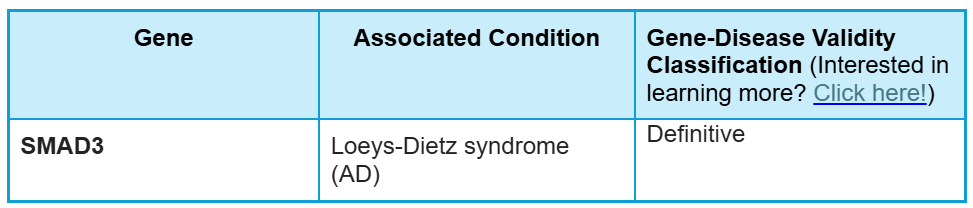
The SMAD3 gene (NM_005902.3), which contains 9 coding exons and is located on chromosome 15q22.33, encodes the mothers against decapentaplegic homolog 3 protein. Pathogenic variants in this gene are known to cause SMAD3-related Loeys-Dietz syndrome (LDS), which is inherited in an autosomal dominant fashion.
SMAD3-related Loeys-Dietz syndrome is characterized by:
● Early onset osteoarthritis and osteochondritis dissecans
● Aortic aneurysm and/or dissection with increased tortuosity of arterial vessels
● Cutaneous findings, including translucent velvety skin, striae, and varices
● Pes planus, scoliosis, and pectus deformity,
● Craniofacial dysmorphism, including craniosynostosis, malar hypoplasia, bifid uvula or cleft palate, and hypertelorism.
Loss of function has been reported as the mechanism of disease for SMAD3-related LDS.
Unique Considerations:
Individuals with SMAD3-related disease show a phenotypic spectrum with intra- and interfamilial variability and reduced penetrance.
Clinical Resources:
Genetic Testing for Inherited Cardiovascular Disease Reference Guide
Understanding your Secondary Findings Result
Ambry Knows Genes:
Peer-Reviewed Publications:
● Smad3 promotes adverse cardiovascular remodeling and dysfunction in doxorubicin-treated hearts (Dec 2022)
Scientific Posters:
● Family Matters: How Segregation Studies Reclassify Variants in Thoracic Aortic Aneurysm and Dissection Multigene Panels (ACMG 2016)
EducateNext Webinars:
● ACMG Secondary Findings Cardiology: Getting to the Heart of the Matter with Kelly Radtke, PhD (September 2024)
To read more about Ambry’s research, visit the ‘Our Research’ dropdown on our website https://www.ambrygen.com/science.
Citations:
● van de Laar IM et al. J Med Genet, 2012 Jan;49:47-57 PMID: 22167769
● Camerota L et al. Genes (Basel), 2019 Sep 28;10(10):764 PMID: 31569402
● Gouda P et al. Int J Cardiol, 2022 Sep;362:158-167 PMID: 35662564
Ambry Genetics Gene-Disease Validity Scheme
Each week, we explore a gene from the ACMG Secondary Findings list—genes identified by the American College of Medical Genetics and Genomics as having clear, actionable health implications. These genes are included because they’re linked to serious but preventable or manageable conditions when identified early.
To learn more about the ACMG Secondary Findings list, click here.
To read all previous Gene Scene emails, click here.