 GENE SCENE SPOTLIGHT: This gene has been in the news (and many commercials) due to the impact that emerging treatments have had for some patients diagnosed with TTR Amyloidosis.
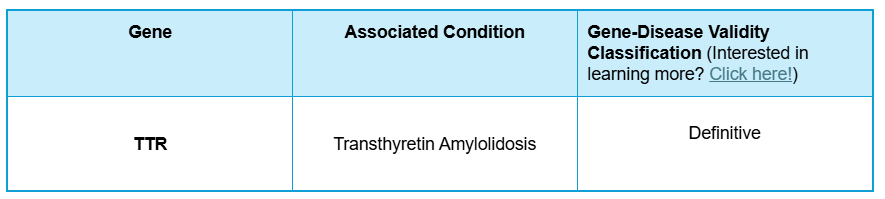
Clinical Phenotype Summary:
The TTR gene encodes the transthyretin protein and is located on chromosome 18q12.1. Pathogenic variants in this gene are known to cause hereditary transthyretin-related amyloidosis (ATTR amyloidosis), which is inherited in an autosomal dominant fashion. However, family history may appear to be negative in the majority of patients due to new mutations in approximately 2/3 of cases, age of onset ranging from 30’s - 70’s, and incomplete penetrance.
ATTR amyloidosis is a multisystem disease caused by abnormal formation and extracellular deposit of TTR protein fibrils in various tissues including the nerves, heart, brain, eyes, intestines, kidneys, and skin. Three broad phenotypes of TTR amyloidosis have been described: polyneuropathy (ATTRm-related polyneuropathy), cardiac amyloidosis (TTR-CA), and leptomeningeal/CNS amyloidosis.
Symptoms may include:
Neurologic: polyneuropathy, numbness, tingling, muscle weakness
Autonomic Dysfunction: gastrointestinal symptoms, orthostatic hypotension, recurrent urinary tract infections, sexual dysfunction
Cardiac: unexplained left ventricular (LV) wall thickening, heart failure with preserved ejection fraction (HFpEF), conduction system disease, aortic stenosis, intolerance to standard HF medications, edema
Musculoskeletal: bilateral carpal tunnel syndrome, lumbar spinal stenosis, biceps tendon rupture
TTR tetramer stabilizers and gene-silencing therapies have been approved as treatments for hereditary TTR amyloidosis, and liver transplantation has been effective in treating individuals with neuropathy forms of the condition.
Unique Considerations:
More than 100 mutations in TTR have been reported in patients with hereditary amyloidosis. The most common mutation, p.V50M (also known as V30M), causes familial amyloid polyneuropathy. Another common mutation, p.V142I (also known as V122I), is associated with cardiac amyloidosis and is carried by approximately 3% of African-Americans. Non-amyloid and protective TTR mutations are known.
The leptomeningeal form generally spares sensory and autonomic functions but amyloid deposits on CNS tissues cause hydrocephalus, seizures, ataxia, dementia, psychosis, motor impairment, and/or intracranial hemorrhage.
It is important to distinguish hereditary TTR amyloidosis from the wild type amyloidosis (also known as Senile systemic amyloidosis), which results from abnormal deposition of non-mutant TTR protein.
Clinical Resources:
Understanding Your Results: Positive TTR - 1 Mutation
Understanding Your Results: Positive TTR - 2 Mutations
Understanding Your Results: Negative TTR
Understanding Your Results: VUS TTR
Ambry Knows Genes:
Peer-Reviewed Publications:
Hereditary Transthyretin Amyloidosis in Patients Referred to a Genetic Testing Program
Scientific Posters:
EducateNext Webinar:
Citations:
Sekijima Y. J Neurol Neurosurg Psychiatry, 2015 Sep;86:1036-43 PMID: 25604431
Finsterer J et al. Acta Neurol Scand, 2019 Feb;139:92-105 PMID: 30295933
Banypersad et al. 2012 J Am Heart Assoc 1:e000364 PMID: 23130126
Ambry Genetics Gene-Disease Validity Scheme
Each week, we explore a gene from the ACMG Secondary Findings list—genes identified by the American College of Medical Genetics and Genomics as having clear, actionable health implications. These genes are included because they’re linked to serious but preventable or manageable conditions when identified early.
To learn more about the ACMG Secondary Findings list, click here.
To read all previous Gene Scene emails, click here.