
Welcome to the Gene Scene! Each week, we will explore a gene from the ACMG Secondary Findings list—genes identified by the American College of Medical Genetics and Genomics as having clear, actionable health implications. These genes are included because they’re linked to serious but preventable or manageable conditions when identified early. Here, we focus on the condition that led to the gene’s inclusion on the list, providing clear, relevant information that supports your clinic. To subscribe to the Gene Scene, contact your local GSL or send a request to info@ambrygen.com.
To access the Gene Scene archives, visit our blog.
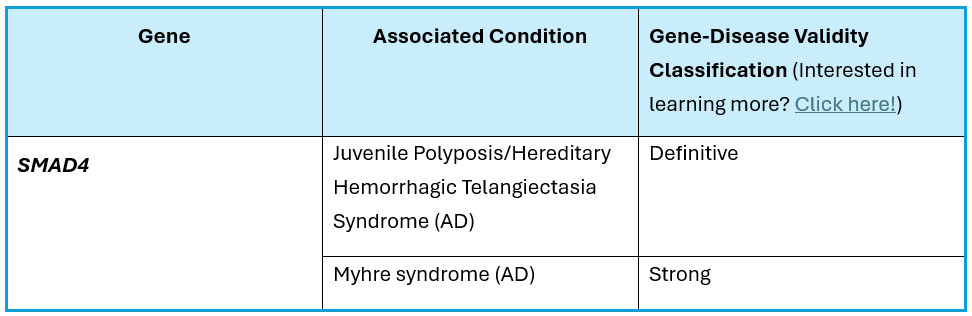
Clinical Phenotype Summary:
The SMAD4 gene (NM_005359.5) is located on chromosome 18q21.2, encodes the mothers against decapentaplegic homolog 4 protein, and contains 11 coding exons. Pathogenic variants in this gene are known to cause a spectrum of conditions, including isolated juvenile polyposis syndrome (JPS) and a combined syndrome of JPS with hereditary hemorrhagic telangiectasia (HHT), which are inherited in an autosomal dominant fashion. In addition, missense variants at amino acids 496 and 500 are known to cause Myhre syndrome, which is inherited in an autosomal dominant fashion.
JPS is characterized by the presence of hamartomatous (specifically, juvenile type) polyps in the gastrointestinal tract. Individuals with SMAD4-related JPS have a significantly increased risk for:
• colon cancer (up to 50% lifetime risk), and
• gastric cancer (up to 21% lifetime risk).
In addition to JPS-associated disease, SMAD4-related JPS-HHT is characterized by a significantly increased risk for:
• arteriovenous malformations (AVMs),
• epistaxis (nosebleeds),
• telangiectasias, and
• thoracic aortic disease such as dilation or dissection.
The penetrance of SMAD4 pathogenic variants associated with JPS and JPS-HHT is incomplete, and variable expressivity is observed; therefore, cancer risks and phenotype will differ based on individual and family history. Loss of function has been reported as the mechanism of disease for SMAD4-related JPS-HHT.
Myhre syndrome is characterized by:
• short stature,
• brachydactyly,
• firm/thick skin,
• impaired joint mobility,
• intellectual disability,
• hearing loss, and
• recurrent ear infections.
Variable expressivity of Myhre syndrome is observed. Variable features include:
• distinct facial features (including midface hypoplasia, prognathism, short palpebral fissures, narrow mouth, and thin upper lip),
• variable cardiovascular abnormalities (notably arterial stenosis, hypertension, pericardial disease, and congenital heart defects),
• restrictive airway disease, visual abnormalities (strabismus, hypermetropia),
• precocious puberty,
• undescended testes in males,
• developmental/motor delays, and
• autism spectrum disorder.
Gain of function has been reported as the mechanism of disease for Myhre syndrome.
Unique Considerations:
Myhre syndrome is tied to missense variants impacting amino acids 496 and 500 instead of Juvenile Polyposis Syndrome. Variant position impacts patient phenotype.
Clinical Resources:
Clinician Management Resource and Understanding Your Results for SMAD4 (Juvenile Polyposis Syndrome)
Ambry Knows Genes:
Peer-Reviewed Publications:
• Mutations in RASA1 and GDF2 identified in patients with clinical features of hereditary hemorrhagic telangiectasia (November 2015)
• Processed Pseudogene Confounding Deletion/Duplication Assays for SMAD4 (September 2015)
Citations:
• Jasperson KW. Cancer J. 2012 Jul-Aug;18(4):328-33 PMID: 22846733
• Aretz S et al. J Med Genet. 2007 Nov;44(11):702-9 PMID: 17873119
• Syngal S et al. Am J Gastroenterol. 2015 Feb; 110(2): 223–263 PMID: 25645574
• Ishida H et al. Surg Today. 2018 Mar;48(3):253-263 PMID: 28550623
• MacFarland S et al. Cancer Prev Res Phila 2021 Feb;14(2):215-222 PMID: 33097490
• Singh AD et al. Gastrointest Endosc. 2023 Mar; 97(3):407-414.e1 PMID: 36265529
• Faughnan M et al. J Med Genet. 2011 Feb;48(2):73-87 PMID: 19553198
• Wain K et al. Genet Med. 2014 Aug; 16(8): 588–593 PMID: 24525918
• Vanbelleghem E, et al. (2024) Eur J Hum Genet 32(9):1086-1094 PMID: 38997468
• Lin AE, et al. (2024) Am J Med Genet A 194(10):e63638 PMID: 38779990
• Brand MR, et al. (2025) Am J Med Genet C Semin Med Genet Jun 6:e32145 PMID: 41355326
• Ambry Genetics Gene-Disease Validity Scheme
Each week, we explore a gene from the ACMG Secondary Findings list—genes identified by the American College of Medical Genetics and Genomics as having clear, actionable health implications. These genes are included because they’re linked to serious but preventable or manageable conditions when identified early.
To learn more about the ACMG Secondary Findings list, click here
To reach all previous Gene Scene emails, click here.