
Welcome to the Gene Scene! Each week, we will explore a gene from the ACMG Secondary Findings list—genes identified by the American College of Medical Genetics and Genomics as having clear, actionable health implications. These genes are included because they’re linked to serious but preventable or manageable conditions when identified early. Here, we focus on the condition that led to the gene’s inclusion on the list, providing clear, relevant information that supports your clinic. To subscribe to the Gene Scene, contact your local GSL or send a request to info@ambrygen.com.
To access the Gene Scene archives, visit our blog.
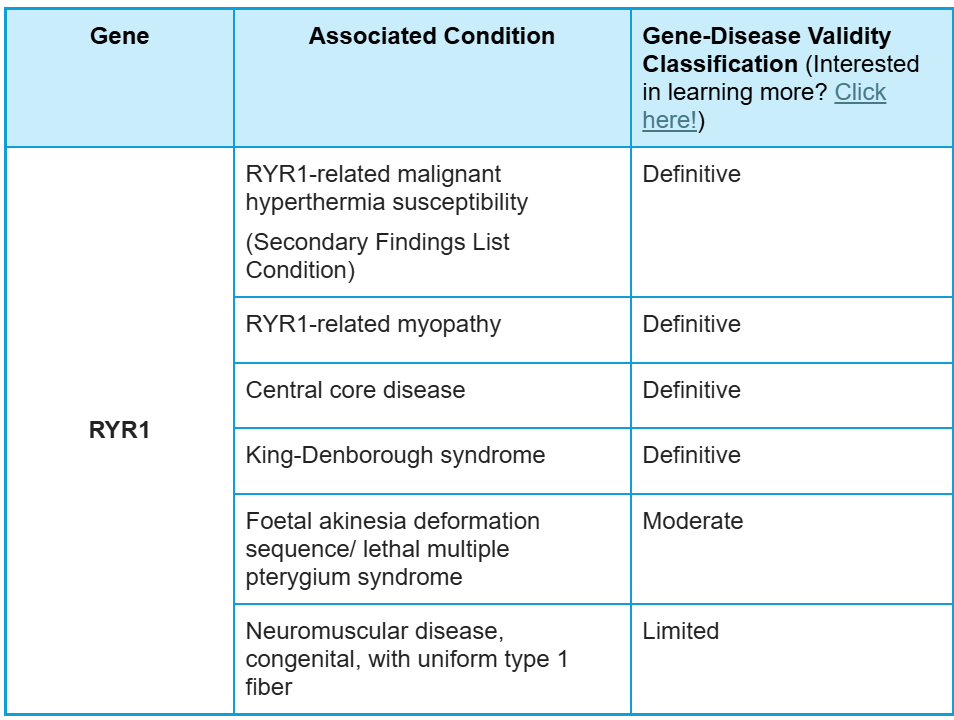
Clinical Phenotype Summary:
The RYR1 gene is located on chromosome 19q13.2 and encodes ryanodine receptor 1 protein. Pathogenic variants in this gene are known to cause RYR1-related malignant hyperthermia susceptibility (MHS), which is inherited in an autosomal dominant fashion, and a spectrum of RYR1-related myopathies including central core disease (CCD), multi-minicore disease (MmD), dusty core disease (DuCD), centronuclear myopathy (CNM), and King-Denborough Syndrome (KDS), which can be inherited in an autosomal dominant or autosomal recessive fashion.
RYR1-related malignant hyperthermia susceptibility (MHS) is characterized by:
- Respiratory and metabolic acidosis
- Unexplained sinus or ventricular tachycardia
- Ventricular fibrillation
- Muscle rigidity and breakdown
- Temperature increase
Symptom onset occurs in response to inhalational anesthetics and the muscle relaxant suxamethonium. Variable expressivity and/or reduced penetrance have been reported for RYR1-related MHS. Mechanism of disease is gain of function.
RYR1-related myopathies are clinically and histologically heterogeneous with a highly variable age of onset. Affected individuals may present with differing degrees of muscle weakness and fatigability, hypotonia, motor delay, joint laxity, contractures, respiratory insufficiency, skeletal abnormalities, ocular abnormalities, dysmorphic facial features, abnormal findings on muscle biopsy, and susceptibility to malignant hyperthermia. King-Denborough syndrome describes a clinical phenotype characterized by congenital myopathy, susceptibility to malignant hyperthermia and/or exertional rhabdomyolysis, skeletal abnormalities, dysmorphic facial features, and abnormal muscle biopsy. Pathologic findings on muscle biopsy have also been reported to change with age. Variable expressivity is observed with RYR1-related myopathies. The mechanism of disease for RYR1-related myopathies is unclear for all forms.
Clinical Resources:
Understanding Your Positive Cardiomyopathy Genetic Test Result
Citations:
· Riazi, Sheila, et al. GeneReviews® [web] (2025). PMID: 20301325
· Johnston, Jennifer J., et al. Human molecular genetics 31.23 (2022): 4087-4093. PMID: 35849058
· Snoeck, M., et al. European journal of neurology 22.7 (2015): 1094-1112. PMID: 25960145
· Lawal, Tokunbor A., et al. Skeletal muscle 10.1 (2020): 32. PMID: 33190635
· Fusto, Aurora, et al. Acta Neuropathologica Communications 10.1 (2022): 54. PMID: 35428369
Ambry Genetics Gene-Disease Validity Scheme
Each week, we explore a gene from the ACMG Secondary Findings list—genes identified by the American College of Medical Genetics and Genomics as having clear, actionable health implications. These genes are included because they’re linked to serious but preventable or manageable conditions when identified early.
To learn more about the ACMG Secondary Findings list, click here
To reach all previous Gene Scene emails, click here.