
Welcome to the Gene Scene! Each week, we will explore a gene from the ACMG Secondary Findings list—genes identified by the American College of Medical Genetics and Genomics as having clear, actionable health implications. These genes are included because they’re linked to serious but preventable or manageable conditions when identified early. Here, we focus on the condition that led to the gene’s inclusion on the list, providing clear, relevant information that supports your clinic. To subscribe to the Gene Scene, contact your local GSL or send a request to info@ambrygen.com.
To access the Gene Scene archives, visit our blog.
Clinical Phenotype Summary:
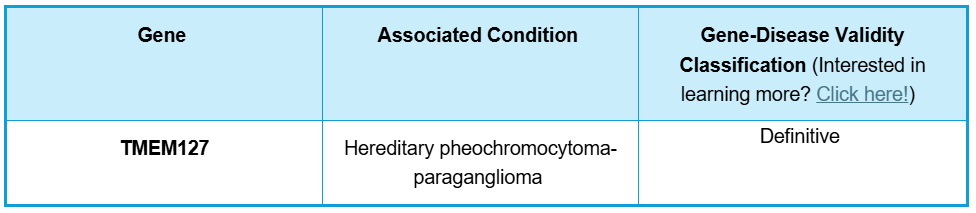
The TMEM127 gene (NM_017849.3) is located on chromosome 2q11.2, encodes the transmembrane protein 127, and contains 3 coding exons. Pathogenic variants in this gene cause TMEM127-related hereditary pheochromocytoma-paraganglioma (PCC-PGL), which is inherited in an autosomal dominant fashion.
Pathogenic variants in TMEM127 confer a significantly increased risk for predominantly unilateral PCCs; however, individuals with bilateral PCC as well as extra-adrenal PGLs have also been reported. Lifetime risks for PCC or PGL in individuals with pathogenic TMEM127 variants are currently not well-defined, though estimates range from 30-40%. The average age of onset is typically around the 5th decade of life, with a reported malignancy rate of less than 3%. Pathogenic TMEM127 variants are estimated to account for about 2% of those diagnosed with hereditary PCC-PGL.
Loss of function has been reported as the mechanism of disease for TMEM127-related hereditary PCC-PGL.
Unique Considerations:
Renal tumors have been reported in individuals with pathogenic variants in TMEM127; however current evidence is insufficient to support a clear increase in risk over the general population
Clinical Resources:
Clinician Management Resource for Hereditary Pheochromocytoma/Paraganglioma Syndrome
Ambry Knows Genes:
Scientific Poster:
Ellis et al. Characterization of TMEM127-related tumor predisposition in a multigene panel testing cohort. ACMG 2026. Abstract / Poster
Citations:
- Qin Y et al. Nat Genet. 2010 Mar;42(3):229-33. PMID: 20154675
- Yao L et al. JAMA. 2010 Dec;304(23):2611-9. PMID: 21156949
- Welander J et al. Endocr. Relat. Cancer. 2011 Dec;18(6):R253-76. PMID: 22041710
- Toledo SP et al. J Clin Endocrinol Metab. 2015 Feb;100(2):E308-18. PMID: 25389632
- Bausch B et al. JAMA Oncol. 2017 Sep;3(9):1204-1212. PMID: 28384794
- Casey RT et al. J Clin Endocrinol Metab 2017 Nov;102(11):4013-4022. PMID: 28973655
- Muth A et al. J Intern Med. 2019 Feb;285(2):187-20. PMID: 30536464
- Armaiz-Pena G et al. J Clin Endocrinol Metab. 2021 Jan;106(1):e350-36. PMID: 33051659
- Ambry Genetics Gene-Disease Validity Scheme
Each week, we explore a gene from the ACMG Secondary Findings list—genes identified by the American College of Medical Genetics and Genomics as having clear, actionable health implications. These genes are included because they’re linked to serious but preventable or manageable conditions when identified early.
To learn more about the ACMG Secondary Findings list, click here.
To read all previous Gene Scene emails, click here.