 Welcome to the Gene Scene! Each week, we will explore a gene from the ACMG Secondary Findings list—genes identified by the American College of Medical Genetics and Genomics as having clear, actionable health implications. These genes are included because they’re linked to serious but preventable or manageable conditions when identified early. Here, we focus on the condition that led to the gene’s inclusion on the list, providing clear, relevant information that supports your clinic. To subscribe to the Gene Scene, contact your local GSL or send a request to info@ambrygen.com.
To access the Gene Scene archives, visit our blog.
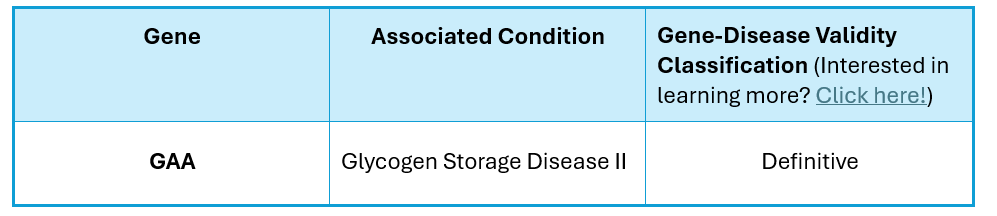
Clinical Phenotype Summary:
The GAA gene (NM_000152) is located on chromosome 17q25.3 and encodes lysosomal alpha-glucosidase. Pathogenic variants in this gene are known to cause glycogen storage disease type II, commonly known as Pompe disease, which is inherited in an autosomal recessive fashion. Glycogen storage disease type II can be subdivided into two presentations, infantile onset Pompe disease (IOPD) and late onset Pompe disease (LOPD).
IOPD is characterized by:
• Onset: By 12 months of age
• Poor Feeding
• Poor Growth
• Profound hypotonia
• Motor delay
• Respiratory infections/difficulty
• Cardiomegaly
• Progressive cardiomyopathy
• Hepatomegaly
LOPD is characterized by:
• Onset: Childhood → Adolescence → Adulthood
• Progressive proximal muscle weakness
• Scoliosis
• Respiratory insufficiency
• Poor weight gain/maintenance
• Gait abnormalities
• Muscle pain
Unique Considerations:
In general, the lower the GAA enzyme activity, the earlier the age of onset of disease:
• IOPD is associated with a complete deficiency of GAA enzyme activity (<1% activity)
• LOPD is associated with partial deficiency of GAA enzyme activity (2%-40% activity)
Pseudodeficiency (PD) alleles are a challenging aspect of Glycogen Storage Disease Type II testing. PD alleles cause low enzyme activity in laboratory tests, but do not cause clinical disease. Several pseudodeficiency alleles, including c.1726G>A (p.Gly576Ser) and c.2065G>A (p.Glu689Lys) are relatively common in individuals of Asian ancestry.
Lastly, there are FDA approved treatments available for Pompe Disease in the form of enzyme replacement therapy (ERT).
Clinical Resources:
• Understanding your Secondary Findings Result
Citations:
• Chan J, Desai AK, Kazi ZB, et al. The emerging phenotype of late-onset Pompe disease: A systematic literature review. Mol Genet Metab. 2017;120(3):163-172. (PMID: 33554498)
• Bay LB, Denzler I, Durand C, et al. Infantile-onset Pompe disease: Diagnosis and management. Enfermedad de Pompe infantil: Diagnóstico y tratamiento. Arch Argent Pediatr. 2019;117(4):271-278. (PMID: 31339275)
• Davison JE. Advances in diagnosis and management of Pompe disease. J Mother Child. 2020;24(2):3-8. Published 2020 Oct 2. (PMID: 33554498)
• Hahn A, Schänzer A. Long-term outcome and unmet needs in infantile-onset Pompe disease. Ann Transl Med. 2019;7(13):283. (PMID: 31392195)
• Kishnani PS, Hwu WL, Mandel H, et al. A retrospective, multinational, multicenter study on the natural history of infantile-onset Pompe disease. J Pediatr. 2006;148(5):671-676. (PMID: 16737883)
Ambry Genetics Gene-Disease Validity Scheme
Each week, we explore a gene from the ACMG Secondary Findings list—genes identified by the American College of Medical Genetics and Genomics as having clear, actionable health implications. These genes are included because they’re linked to serious but preventable or manageable conditions when identified early.
To learn more about the ACMG Secondary Findings list, click here
To reach all previous Gene Scene emails, click here.