
Welcome to the Gene Scene! Each week, we will explore a gene from the ACMG Secondary Findings list—genes identified by the American College of Medical Genetics and Genomics as having clear, actionable health implications. These genes are included because they’re linked to serious but preventable or manageable conditions when identified early. Here, we focus on the condition that led to the gene’s inclusion on the list, providing clear, relevant information that supports your clinic. To subscribe to the Gene Scene, contact your local GSL or send a request to info@ambrygen.com.
To access the Gene Scene archives, visit our blog.
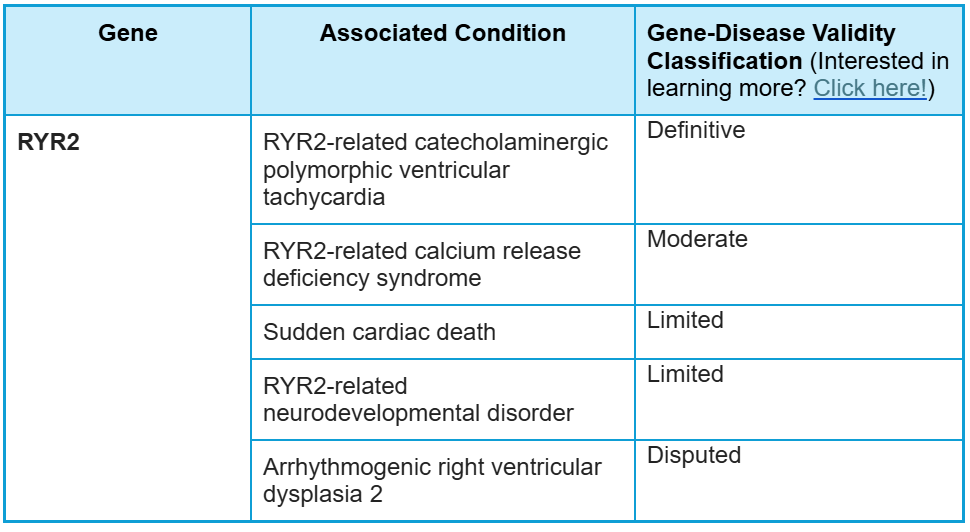
Clinical Phenotype Summary:
The RYR2 gene (NM_001035.2), which contains 105 coding exons and is located on chromosome 1q43, encodes the ryanodine receptor 2 protein. Pathogenic variants in this gene are associated with a spectrum of RYR2-related ventricular arrhythmias, including catecholaminergic polymorphic ventricular tachycardia (CPVT) and calcium release deficiency syndrome (CRDS), which are inherited in an autosomal dominant fashion.
Diagnostic criteria for CPVT include:
● Exercise- or emotion-induced bidirectional or polymorphic ventricular tachycardia
● Structurally normal heart
● Normal resting ECG
Individuals with CRDS have:
● Syncope
● Sudden cardiac arrest
● Risk for sudden death
● Normal exercise stress testing and/or adrenaline challenge results
Age of onset for RYR2-related ventricular arrhythmias is often in the first or second decade of life, and clinical manifestations are prompted by physical activity or emotional stress; however, reduced penetrance has been reported. Therapy options include beta-blockers, flecainide, implantable cardioverter defibrillator (ICD), and left cardiac sympathetic denervation.
Unique Considerations:
Pathogenic variants in RYR2 are estimated to account for approximately 70% of CPVT cases, with the majority being missense changes; however, exon 3 gross deletions leading to in-frame exon skipping have also been described in several unrelated families with CPVT and complex cardiac phenotypes. Altered channel function has been reported as the mechanism of disease for RYR2-related ventricular arrhythmias.
Clinical Resources:
Understanding Your Positive Arrhythmia Report
Understanding Your Negative Arrhythmia Report
Understanding Your VUS Arrhythmia Report
Hereditary Cardiovascular Testing
Ambry Knows Genes:
Webinars:
● ACMG Secondary Findings Cardiology: Getting to the Heart of the Matter with Kelly Radtke, PhD (September 2024)
● Medical Management for Hereditary Cardiomyopathies with John L. Jeffries, MD, MPH, FACC, FAHA, FAAP, FHFSA, FRCPE (September 2021)
● Arrhythmogenic Disorders: Current Testing and Management Strategies with Marina Cerrone, MD (May 2021)
To read more about Ambry’s research on this gene. Visit the ‘Our Research’ dropdown on our website https://www.ambrygen.com/science.
Citations:
● Campbell MJ et al. Am J Med Genet A, 2015 Sep;167A:2197-200. PMID: 26018045
● Priori SG et al. J Am Coll Cardiol, 2021 05;77:2592-2612. PMID: 34016269
● Roston TM et al. JAMA Cardiol, 2022 01;7:84-92. PMID: 34730774
● Fowler ED et al. Biomolecules, 2022 07;12. PMID: 35892340
Ambry Genetics Gene-Disease Validity Scheme
Each week, we explore a gene from the ACMG Secondary Findings list—genes identified by the American College of Medical Genetics and Genomics as having clear, actionable health implications. These genes are included because they’re linked to serious but preventable or manageable conditions when identified early.
To learn more about the ACMG Secondary Findings list, click here.
To read all previous Gene Scene emails, click here.