
to the Gene Scene! Each week, we will explore a gene from the ACMG Secondary Findings list—genes identified by the American College of Medical Genetics and Genomics as having clear, actionable health implications. These genes are included because they’re linked to serious but preventable or manageable conditions when identified early. Here, we focus on the condition that led to the gene’s inclusion on the list, providing clear, relevant information that supports your clinic. To subscribe to the Gene Scene, contact your local GSL or send a request to info@ambrygen.com.
To access the Gene Scene archives, visit our blog. 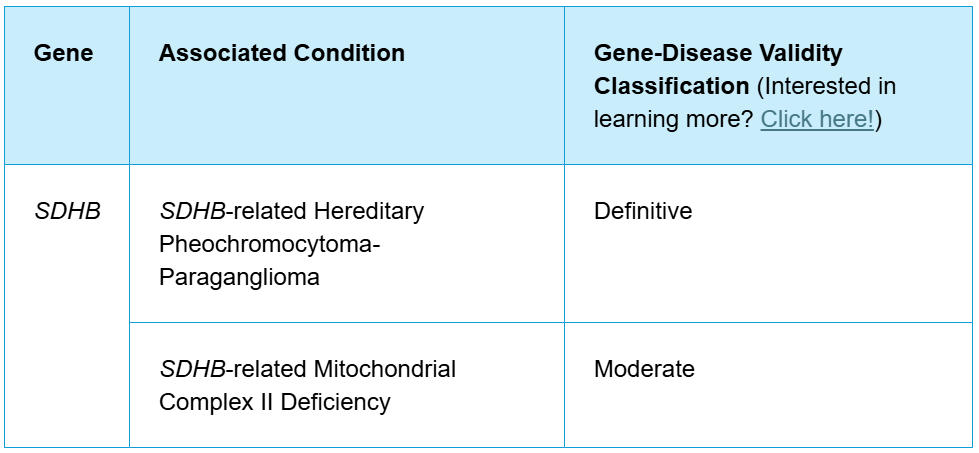
Clinical Phenotype Summary:
SDHB-related Hereditary Pheochromocytoma-Paraganglioma is characterized by:
- Increased cumulative lifetime risk for paraganglioma or pheochromocytoma (22-47% lifetime risk)
- Increased risk for renal cell carcinoma (4-14% lifetime risk)
- Increased risk for gastrointestinal stromal tumors
- Possible increased risk for pituitary adenomas
- SDHB-associated PGLs are characterized by a higher risk of aggressive behavior/malignancy and development of metastatic disease
SDHB-associated PGLs are characterized by a higher risk of aggressive behavior/malignancy and development of metastatic disease. Penetrance in SDHB-related hereditary PCC-PGL is incomplete and variable expressivity is observed; therefore, cancer risks will differ based on individual and family history.
Loss of function has been reported as the mechanism of disease for SDHB-related hereditary PCC-PGL.
SDHB-related Mitochondrial Complex II Deficiency is characterized by:
- Developmental delay, cardiomyopathy (with or without cardiac conduction defects), spasticity, abnormal brain imaging (such as leukoencephalopathy), or developmental regression following acute illness or infection
- Additional features may include hypotonia, skeletal myopathy, or ophthalmological abnormalities (ptosis, ophthalmoplegia, pigmentary retinopathy, nystagmus, or optic atrophy).
Onset is variable, and can occur in infancy with severe multisystem involvement or in adulthood with isolated cardiac or muscle involvement. Individuals of reproductive age are at 25% risk of having a child with SDHB-related mitochondrial complex II deficiency with each pregnancy when both biological parents have a pathogenic variant in SDHB.
Biallelic loss of function has been reported as the mechanism of disease for SDHB-related mitochondrial complex II deficiency.
Unique Considerations:
Pathogenic variants in this gene account for up to 25% of hereditary PCC-PGL syndrome.
Clinical Resources:
Clinician Management Resource and Understanding Your Results for SDHB (PCC-PGL syndrome)
Ambry Knows Genes:
Peer Reviewed Publication:
Quantifying evidence toward pathogenicity for rare phenotypes: The case of succinate dehydrogenase genes, SDHB and SDHD (January 2022)
Citations:
Andrews KA et al. J. Med. Genet. 2018 06;55:384-394 PMID: 29386252
Jochmanova I et al. J. Cancer Res. Clin. Oncol. 2017 Aug;143:1421-1435 PMID: 28374168
Evenepoel L et al. Genet Med. 2015 Aug;17(8):610-20 PMID: 25394176
Benn DE, et al. (2018) J Med Genet 55(11):729-734 PMID: 30201732
White G, et al. (2022) Endocr Connect 11(2) PMID: 35060925
Alston CL et al. J Med Genet. 2012 Sep;49(9):569-77 PMID: 22972948
Fullerton M, et al. (2020) Mol Genet Metab 131(1):53-65 PMID: 33162331
Ambry Genetics Gene-Disease Validity Scheme
Each week, we explore a gene from the ACMG Secondary Findings list—genes identified by the American College of Medical Genetics and Genomics as having clear, actionable health implications. These genes are included because they’re linked to serious but preventable or manageable conditions when identified early.
To learn more about the ACMG Secondary Findings list, click here.
To read all previous Gene Scene emails, click here.