
Welcome to the Gene Scene! Each week, we will explore a gene from the ACMG Secondary Findings list—genes identified by the American College of Medical Genetics and Genomics as having clear, actionable health implications.These genes are included because they’re linked to serious but preventable or manageable conditions when identified early. Here, we focus on the condition that led to the gene’s inclusion on the list, providing clear, relevant information that supports your clinic. To subscribe to the Gene Scene, contact your local GSL or send a request to info@ambrygen.com.
To access the Gene Scene archives, visit our blog.
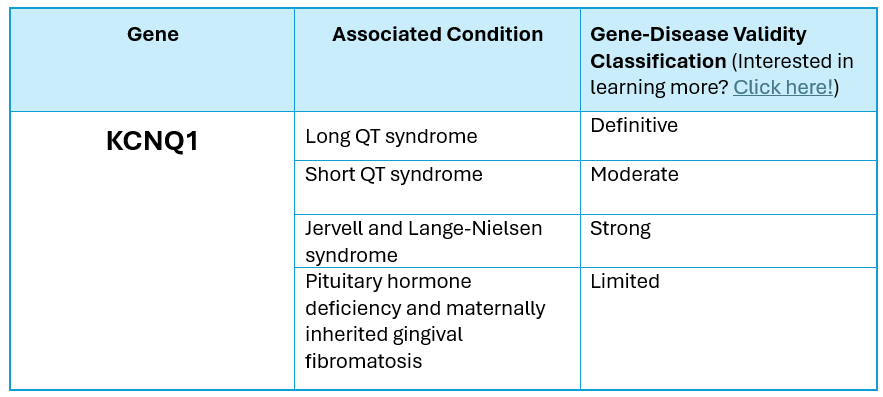
Clinical Phenotype Summary:
The KCNQ1 gene (NM_000218.2) is located on chromosome 11p15.5-p15.4, contains 16 coding exons, and encodes the potassium voltage-gated channel subfamily KQT member 1 protein. Pathogenic variants in this gene are known to cause a spectrum of KCNQ1-related long QT Syndrome (LQTS), including autosomal dominant LQTS1, autosomal-recessive LQTS1 (AR-LQTS), and Jervell and Lange-Nielsen syndrome (JLNS), which is also inherited in an autosomal recessive fashion, as well as KCNQ1-related short QT syndrome (SQTS), which is inherited in an autosomal dominant fashion.
KCNQ1-related long QT syndrome is characterized by:
• Delayed ventricular repolarization
• Prolonged corrected QT (QTc) interval on ECG, and increased risk of syncope
• Seizures
• Sudden death due to ventricular arrhythmias often associated with physical exertion or emotional stress
KCNQ1-related short QT syndrome is characterized by:
• Abbreviated repolarization phase of the cardiac action potential
• Shortened QT interval on ECG
• Increased risk of tachyarrhythmias palpitations, syncope, and sudden death
Jervell and Lange-Nielsen syndrome is characterized by
• Profound congenital bilateral sensorineural deafness
• QTc intervals > 500ms and increased risks for adverse events
Unique Considerations:
While pathogenic variants in KCNQ1 are most commonly known for the autosomal dominant Long QT phenotype, biallelic pathogenic variants in KCNQ1 lead to an autosomal recessive phenotype called Jervell and Lange-Nielsen syndrome.
Clinical Resources:
Understanding Your Positive Arrhythmia Genetic Test Result
Understanding Your VUS Arrhythmia Genetic Test Result
Additional Resources:
Cardiogenetic testing reference guide
Genetic Testing for Inherited Cardiovascular Disease Reference Guide
Recommendations & Guidelines for Cardiovascular Genetic Testing
Understanding your Secondary Findings Result
Ambry Knows Genes:
EducateNext Webinars:
• ACMG Secondary Findings Cardiology: Getting to the Heart of the Matter with Kelly Radtke, PhD (Sept 2024)
• When Panel Testing Misses the Mark: Navigating Whole Exome Sequencing for Cardiovascular Genomic Disorders with Megan Betts, MS, LGC (March 2024)
• Considerations of Disease Specific Criteria for Variant Classification on Cardiogenetic Panels with Meghan Town (Sept 2023)
• Inherited Arrhythmias Webinar - Part 1: The Pregnancy Journey with Inherited Arrhythmia (August 2016)
• Inherited Arrhythmias Webinar - Part 2: The Family Experience with Sudden Death (August 2016)
• Inherited Arrhythmias Webinar - Part 3: Cardiovascular Genetic Testing Practices around the World (Sept 2016)
To read more about Ambry’s research on this gene. Visit the "Our Research" dropdown on our website https://www.ambrygen.com/science.
Citations:
• Giudicessi, J. R., & Ackerman, M. J. Circ Cardiovasc Genet. 2013 Apr;6(2):193-200 PMID: 23392653
• Campuzano O et al. Front Cardiovasc Med. 2018 PMID: 30420954
• Giudicessi, J. R., & Ackerman, M. J. Curr Probl Cardiol. 2013 Oct;38(10):417-55. PMID: 24093767
• Bellocq C et al. Circulation. 2004 May 25;109(20):2394-7. PMID: 15159330
• Chan PJ et al. J Gen Physiol. 2012 Feb;139(2):135-44. PMID: 22250012
• Tranebjærg L et al. GeneReviews. 2002 Jul 29 [updated 2017 Aug 17] PMID: 20301579
• Groffen, A. J. et al. GeneReviews. 2003 Feb 20 [updated 2024 Mar 21] PMID: 20301308
Ambry Genetics Gene-Disease Validity Scheme
Each week, we explore a gene from the ACMG Secondary Findings list—genes identified by the American College of Medical Genetics and Genomics as having clear, actionable health implications. These genes are included because they’re linked to serious but preventable or manageable conditions when identified early.
To learn more about the ACMG Secondary Findings list, click here.
To read all previous Gene Scene emails, click here.