
Welcome to the Gene Scene! Each week, we will explore a gene from the ACMG Secondary Findings list—genes identified by the American College of Medical Genetics and Genomics as having clear, actionable health implications. These genes are included because they’re linked to serious but preventable or manageable conditions when identified early. Here, we focus on the condition that led to the gene’s inclusion on the list, providing clear, relevant information that supports your clinic. To subscribe to the Gene Scene, contact your local GSL or send a request to info@ambrygen.com.
To access the Gene Scene archives, visit our blog.
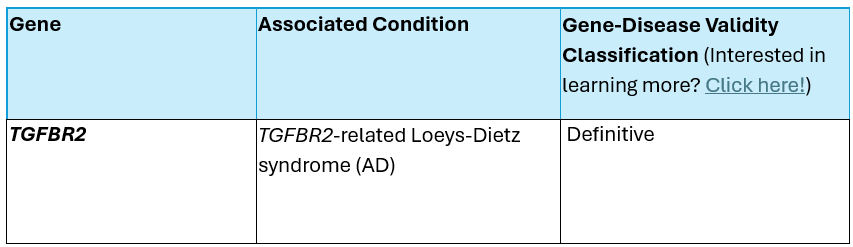
Clinical Phenotype Summary:
The TGFBR2 gene (NM_003242.5) is located on chromosome 3p24.1, contains 7 coding exons, and encodes the TGF-beta receptor type-2 protein. Pathogenic variants in this gene are known to cause TGFBR2-related Loeys-Dietz syndrome (LDS), a connective tissue disorder which is inherited in an autosomal dominant fashion.
TGFBR2-related Loeys-Dietz syndrome is characterized by:
• Head and neck arterial tortuosity
• Aortic root aneurysm or dissection
• Hypertelorism
• Cleft palate
• Bifid/broad uvula
Additional features seen in a minority of patients:
• Clubfeet
• Velvety or translucent skin
• Easy bruising
• Dystrophic scars
• Pectus deformity
• Arachnodactyly
• Joint laxity
• Scoliosis
• Congenital heart defects
The arterial/aortic tortuosity and aneurysms in patients with TGFBR2-related LDS are rapidly progressive, leading to risk of rupture at early ages. There is risk for pregnancy-related complications including uterine rupture.
Unique Considerations:
Although penetrance of TGFBR2-related LDS is reportedly almost 100%, intrafamilial clinical variability, somatic mosaicism and rare cases of non-penetrance have been reported. Dominant negative has been reported as the mechanism of disease for TGFBR2-related LDS.
Clinical Resources:
Understanding Your Positive Genetic Test Result for Thoracic Aortic Aneurysms/Dissections (TAAD) or Related Conditions
Understanding Your Positive Secondary Findings Test Result
Ambry Knows Genes:
Scientific Posters:
• TGFBR2 novel variant, p.Y470D, likely disease causing in large Loeys-Dietz kindred (ACMG, 2015)
Citations:
• Loeys BL et al. Nat Genet, 2005 Mar;37:275-81. PMID: 15731757
• Loeys BL et al. N Engl J Med, 2006 Aug;355:788-98. PMID: 16928994
• Attias D et al. Circulation, 2009 Dec;120:2541-9. PMID: 19996017
• Jondeau G et al. Circ Cardiovasc Genet, 2016 Dec;9:548-558. PMID: 27879313
• Loeys BL, et al. GeneReviews. 2008 Feb 28 [Updated 2024 Sep 12]. PMID: 20301312
• Takeda N et al. Int J Mol Sci, 2018 Jul;19(7). PMID: 30037098
Ambry Genetics Gene-Disease Validity Scheme
Each week, we explore a gene from the ACMG Secondary Findings list—genes identified by the American College of Medical Genetics and Genomics as having clear, actionable health implications. These genes are included because they’re linked to serious but preventable or manageable conditions when identified early.
To learn more about the ACMG Secondary Findings list, click here.
To read all previous Gene Scene emails, click here.