
Welcome to the Gene Scene! Each week, we will explore a gene from the ACMG Secondary Findings list—genes identified by the American College of Medical Genetics and Genomics as having clear, actionable health implications. These genes are included because they’re linked to serious but preventable or manageable conditions when identified early. Here, we focus on the condition that led to the gene’s inclusion on the list, providing clear, relevant information that supports your clinic. To subscribe to the Gene Scene, contact your local GSL or send a request to info@ambrygen.com.
To access the Gene Scene archives, visit our blog.
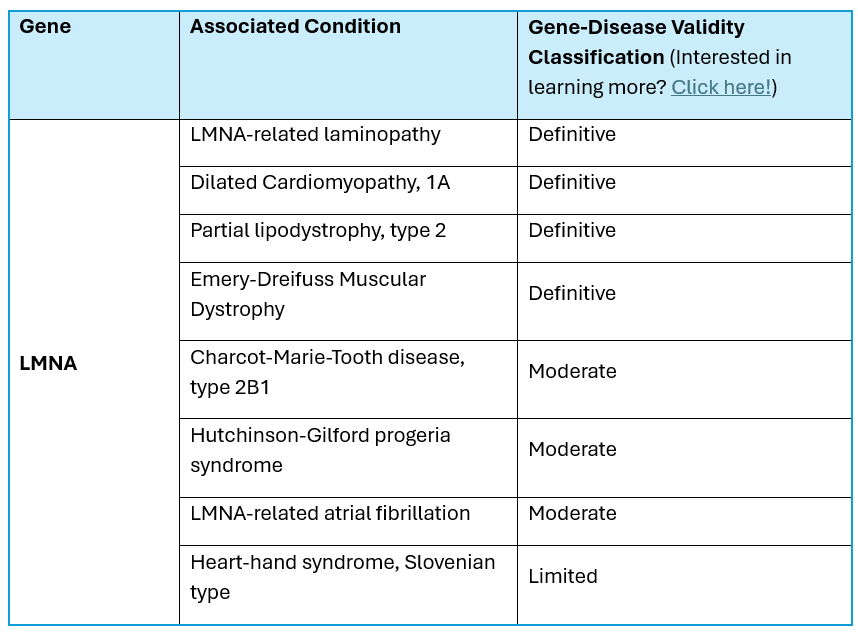
Clinical Phenotype Summary:
The LMNA gene (NM_170707.2) contains 12 coding exons and is located on chromosome 1q22, encoding the lamin protein. Lamin A and C, together with lamin B, are the major constituents of the nuclear lamina which plays roles in cellular organization and gene expression. Pathogenic variants in LMNA are associated with more than 10 distinct disorders with high clinical variability, referred to as the laminopathies. These disorders can be inherited in an autosomal dominant or autosomal recessive fashion.
LMNA-related laminopathies include dilated cardiomyopathy with conduction defects (DCM), Emery-Dreifuss muscular dystrophy (EDMD), and the lipodystrophies.
Patients with EDMD present with progressive muscle weakness and wasting, which may be restricted to the limb-girdle skeletal muscles, and are at risk for sudden death due to cardiac arrhythmia. LMNA-related dilated cardiomyopathy generally presents in early to mid-adulthood with symptomatic conduction system disease or arrhythmias, or with symptomatic dilated cardiomyopathy including heart failure or embolus from a left ventricular mural thrombus; sudden cardiac death may occur and can be the presenting manifestation.
The laminopathies also include Hutchinson-Gilford progeria syndrome (HGPS), which is an autosomal dominant condition that generally occurs de novo, limb-girdle muscular dystrophy, left ventricular noncompaction, Charcot-Marie-Tooth disease 2B1 (CMT2B1), which is inherited in an autosomal recessive fashion, among others.
LMNA-related lipodystrophies are characterized by later age of onset of progressive abnormal subcutaneous adipose tissue distribution and may present with overlapping features of other LMNA-related conditions; in particular, mandibuloacral dysplasia is a lipodystrophy phenotype that also presents with phenoacrosteolysis, skin changes, clavicular hypoplasia, and dysmorphic facial features resembling those seen in HGPS.
The LMNA-related laminopathies are characterized by significant variable expressivity. Findings may include:
• Arrhythmias
• Symptomatic DCM
• Sudden Cardiac Arrest
• Progressive muscle weakness or wasting
• Risk for SCD due to arrhythmia
• Abnormal subcutaneous adipose tissue distribution (lipodystrophies)
• Mandibuloacral dysplasia (lipodystrophies)
Unique Considerations:
Specific variants in LMNA are associated with:
1. Charcot-Marie-Tooth type 2B1: LMNA, c.892C>T (p.R298C) is associated with CMT type 2B1, which is an autosomal recessive condition characterized by mild to severe progressive distal limb and proximal lower limb muscle weakness and atrophy among other features.
2. Hutchinson-Gilford progeria syndrome: LMNA, c.1824C>T (p.Gly608Gly) is associated with Hutchinson-Gilford progeria syndrome, which is an autosomal dominant condition characterized by accelerated aging among other significant clinical findings.
Clinical Resources:
• Understanding Your Positive Cardiovascular Genetic Test Result
• Cardiogenetic Testing Reference Guide
Educate Next Webinars:
• ACMG Secondary Findings Cardiology: Getting to the Heart of the Matter (09/2024)
• The Power of Cardiovascular Genetic Testing: From Implementation to Targeted Therapies (02/2024)
• Considerations of Disease Specific Criteria for Variant Classification on Cardiogenetic Panels (09/2023)
• Field Guidance for Genetic Screening in Patients with Cardiomyopathies (05/2023)
Ambry Knows Genes:
To read more about Ambry’s research on this gene. Visit the ‘Our Research’ dropdown on our website https://www.ambrygen.com/science.
Citations:
• Choi et al. Nat Genet. 2025 Mar;57(3):548-562. PMID: 40050430.
• Iavarone et al. Eur Heart J Case Rep, 2023 Oct;7(12):ytad532. PMID: 38130860.
• Tremblay-Gravel el al. Circ Genom Precis Med, 2023 Feb; 16(1):e003480. PMID: 36548481.
• D’Arezzo Pessente el al. Front Cardiovasc Med, 2022 Apr 5:9:823717. PMID: 35449878.
• Ahmed et al. Mol Neurobiol, 2018 May;55(5):4417-4427. PMID: 28660486.
Ambry Genetics Gene-Disease Validity Scheme
Each week, we explore a gene from the ACMG Secondary Findings list—genes identified by the American College of Medical Genetics and Genomics as having clear, actionable health implications. These genes are included because they’re linked to serious but preventable or manageable conditions when identified early.
To learn more about the ACMG Secondary Findings list, click here.
To read all previous Gene Scene emails, click here.