
Welcome to the Gene Scene! Each week, we will explore a gene from the ACMG Secondary Findings list—genes identified by the American College of Medical Genetics and Genomics as having clear, actionable health implications. These genes are included because they’re linked to serious but preventable or manageable conditions when identified early. Here, we focus on the condition that led to the gene’s inclusion on the list, providing clear, relevant information that supports your clinic. To subscribe to the Gene Scene, contact your local GSL or send a request to info@ambrygen.com.
To access the Gene Scene archives, visit our blog.
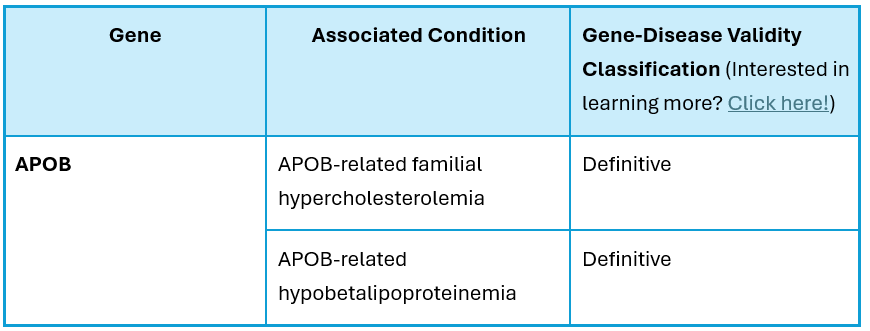
Clinical Phenotype Summary:
The APOB gene (NM_000384.2) contains 29 coding exons, is located on chromosome 2p24.1, and encodes apolipoprotein B-100. Pathogenic variants in this gene are known to cause familial hypercholesterolemia (FH), which is inherited in an autosomal dominant fashion, and hypobetalipoproteinemia, which is inherited in an autosomal recessive fashion.
Familial Hypercholesterolemia is characterized by:
• Extreme hypercholesterolemia defined as LDL-C levels >190 mg/dL (>4.9 mmol/L) or total cholesterol levels >310 mg/dL (>8 mmol/L) in adults and LDL-C levels >160 mg/dL (>4 mmol/L) or total cholesterol levels >230 mg/dL (>6 mmol/L) in children or adolescents
• Premature coronary heart, cerebral, or peripheral vascular disease
• Tendon xanthomas
• Corneal arcus
• Family history of high cholesterol, heart disease, and/or tendon xanthomas
Hypobetalipoproteinemia is characterized by:
• Extremely low levels of triglycerides, LDL-C, and apo B levels (<5th percentile)
• Malabsorption of lipid-soluble vitamins
• Acanthocytosis
• Steatorrhea
• Failure to thrive
• Hepatic steatosis
• Gastrointestinal complications
Without intervention, patients can develop retinal degeneration, ataxia, dysmetria, and proprioception loss.
Carriers are typically asymptomatic but can present biochemically with lowered levels of LDL-C and apo B on a lipid profile.
Unique Considerations:
Pathogenic APOB variants are estimated to account for 1-5% of patients with FH and are located in the LDL-receptor binding domain of the protein. Reduced penetrance of FH due to APOB pathogenic variants has been reported. The mechanism of disease is unclear for FH, while biallelic loss of function is the known mechanism of disease for hypobetalipoproteinemia.
Clinical Resources:
Understanding Your Positive Familial Hypercholesterolemia (FH) Genetic Test Result
Understanding Your VUS Familial Hypercholesterolemia (FH) Genetic Test Result
Understanding Your Positive Secondary Findings Test Result
Ambry Knows Genes:
Scientific Posters:
• Know FH: Mutation Spectrum and Utilization of Cascade Testing for Familial Hypercholesterolemia (ACMG, 2017)
• Genetic Testing as an Effective Diagnostic Tool for Familial Hypercholesterolemia (AHA, 2017)
• Genetic Testing for Familial Hypercholesterolemia (NLA, 2018)
Citations:
• Lee J et al. J Inherit Metab Dis. 2014 May;37(3):333-9. PMID: 24288038
• Najam O et al. Cardiol Ther. 2015 Jan. 4, 25–38. PMID: 25769531
• Whitfield AJ et al. Clin Chem. 2004 Oct;50(10):1725-32. PMID: 15308601
Ambry Genetics Gene-Disease Validity Scheme
Each week, we explore a gene from the ACMG Secondary Findings list—genes identified by the American College of Medical Genetics and Genomics as having clear, actionable health implications. These genes are included because they’re linked to serious but preventable or manageable conditions when identified early.
To learn more about the ACMG Secondary Findings list, click here.
To read all previous Gene Scene emails, click here.