
Welcome to the Gene Scene! Each week, we will explore a gene from the ACMG Secondary Findings list—genes identified by the American College of Medical Genetics and Genomics as having clear, actionable health implications. These genes are included because they’re linked to serious but preventable or manageable conditions when identified early. Here, we focus on the condition that led to the gene’s inclusion on the list, providing clear, relevant information that supports your clinic. To subscribe to the Gene Scene, contact your local GSL or send a request to info@ambrygen.com.
To access the Gene Scene archives, visit our blog.
Clinical Phenotype Summary:
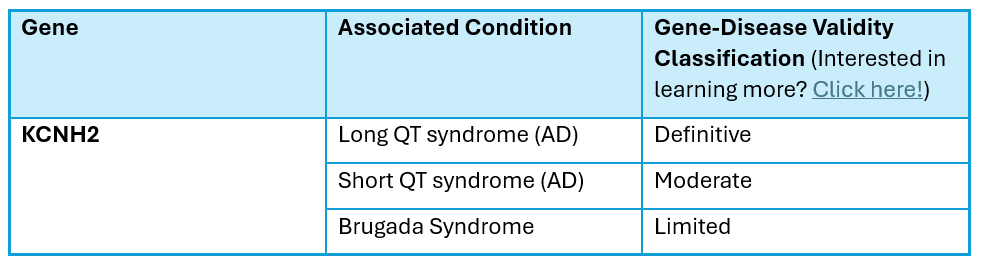
The KCNH2 gene (NM_000238.3) is located on chromosome 7q36.1, contains 15 exons, and encodes the potassium voltage-gated channel subfamily H member 2 protein. Pathogenic variants in this gene are known to cause KCNH2-related long QT syndrome and KCNH2-related short QT syndrome, which are inherited in an autosomal dominant fashion.
KCNH2-related long QT syndrome is characterized by:
• Delayed ventricular and atrial repolarization
• Corrected QT (QTc) prolongation on ECG
• Increased risk for tachyarrhythmia that could cause recurrent syncope, seizures, or sudden death.
Individuals may present with a heterogeneous ECG phenotype ranging from a completely normal resting ECG to extreme QTc prolongation.
Both loss-of-function and dominant negative have been reported as mechanisms of disease for KCNH2-related long QT syndrome.
KCNH2-related short QT syndrome is characterized by:
• A very short QT interval on ECG which can cause syncope, palpitations, and inducible ventricular fibrillation at electrophysiological study.
• Shorter QT intervals (typically below 300 ms) compared to patients with other types of short QT syndrome
• Increased risk to develop atrial and ventricular arrhythmias.
Mechanism of disease is unclear for KCNH2-related short QT syndrome.
Unique Considerations:
Penetrance has been reported to be variable, ranging from 25% to 100%, for variants that cause KCNH2-related short QT syndrome.
Clinical Resources:
Understanding Your Positive Arrhythmia Genetic Test Result
Understanding Your VUS Arrhythmia Genetic Test Result
Cardiogenetic testing reference guide
Genetic Testing for Inherited Cardiovascular Disease Reference Guide
Recommendations & Guidelines for Cardiovascular Genetic Testing
Understanding your Secondary Findings Result
Ambry Knows Genes:
Peer-Reviewed Publications:
• Clinical interpretation of KCNH2 variants using a robust PS3/BS3 functional patch-clamp assay (Jan 2024)
• A calibrated functional patch-clamp assay to enhance clinical variant interpretation in KCNH2-related long QT syndrome (Jul 2022)
Scientific Posters:
• Many testing roads can lead to KCNQ2 diagnosis (AAN 2017)
• Multigene panel testing for arrhythmias: Diagnostic yield and phenotypic spectrum (HRS 2016)
EducateNext Webinars:
• ACMG Secondary Findings Cardiology: Getting to the Heart of the Matter with Kelly Radtke, PhD (September 2024)
• Considerations of Disease Specific Criteria for Variant Classification on Cardiogenetic Panels with Meghan Town (September 2023)
• Arrhythmogenic Disorders: Current Testing and Management Strategies with Marina Cerrone, MD (May 2021)
• Evaluation, Risk Stratification, and Management of Arrhythmogenic Cardiomyopathy with Arthur A.M. Wilde, MD, PhD and Cynthia A. James, ScM, PhD, CGC (March 2021)
• Evaluating the Family After Sudden Death in the Young with Michael J. Ackerman, MD, PhD (November 2020)
• Inherited Arrhythmias Webinar - Part 3: Cardiovascular Genetic Testing Practices around the World (Sept 2016)
• Inherited Arrhythmias Webinar - Part 2: The Family Experience with Sudden Death (August 2016)
• Inherited Arrhythmias Webinar - Part 1: The Pregnancy Journey with Inherited Arrhythmia (August 2016)
Citations:
• Smith JL et al. J Arrhythm, 2016 Oct;32:373-380 PMID: 27761161
• Jongbloed RJ et al. Hum Mutat, 1999 Mar;13:301-310 PMID: 10220144
• Tester DJ et al. Heart Rhythm, 2005 May;2:507-517 PMID: 15840476
• Gaita F et al. Circulation, 2003 Aug;108:965-970 PMID: 12925462
• Harrell DT et al. Int J Cardiol, 2015 Apr:393-402 PMID: 25974115
Ambry Genetics Gene-Disease Validity Scheme
Each week, we explore a gene from the ACMG Secondary Findings list—genes identified by the American College of Medical Genetics and Genomics as having clear, actionable health implications. These genes are included because they’re linked to serious but preventable or manageable conditions when identified early.
To learn more about the ACMG Secondary Findings list, click here.
To read all previous Gene Scene emails, click here.