
Welcome to the Gene Scene! Each week, we will explore a gene from the ACMG Secondary Findings list—genes identified by the American College of Medical Genetics and Genomics as having clear, actionable health implications. These genes are included because they’re linked to serious but preventable or manageable conditions when identified early. Here, we focus on the condition that led to the gene’s inclusion on the list, providing clear, relevant information that supports your clinic. To subscribe to the Gene Scene, contact your local GSL or send a request to info@ambrygen.com.
To access the Gene Scene archives, visit our blog.
Clinical Phenotype Summary
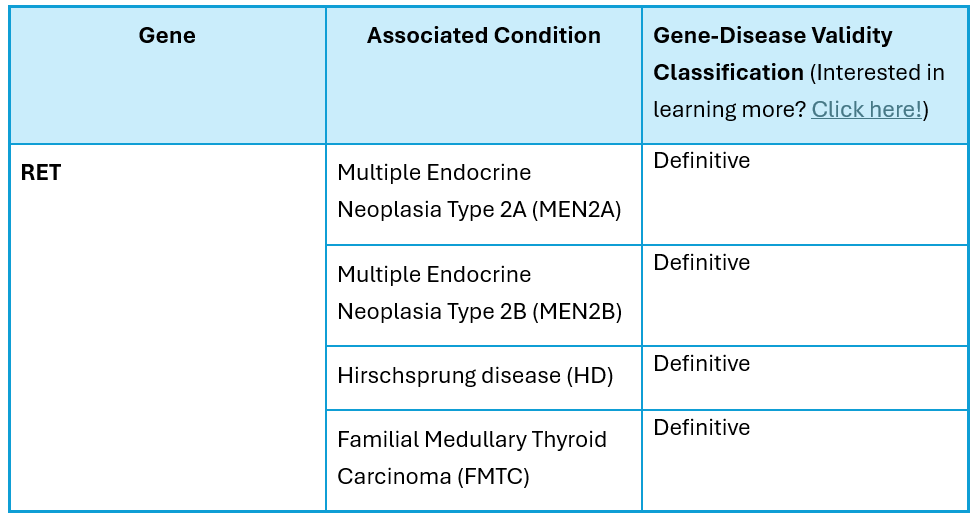
The RET gene encodes a receptor tyrosine kinase. Pathogenic variants in this gene are known to cause a spectrum of tumor predisposing conditions, including multiple endocrine neoplasia type 2A (MEN2A), MEN2B, and familial medullary thyroid carcinoma (FMTC), which are inherited in an autosomal dominant fashion. In addition, pathogenic variants in this gene have been detected in individuals diagnosed with Hirschsprung disease (HD), which is inherited in an autosomal dominant fashion.
MEN2A is the most common subtype of multiple endocrine neoplasia (up to 80% of individuals) and is characterized by increased risk for:
• Medullary Thyroid Carcinoma (MTC): Occurs in 95-100% of affected individuals; it is often the first clinical manifestation.
• Pheochromocytoma: Seen in ~50% of MEN2A; typically bilateral and rarely malignant.
• Primary Hyperparathyroidism: Found in 20–30% of MEN2A cases.
o Distinctive Features (MEN2B): Characterized by mucosal neuromas (on the lips, tongue, and eyelids), a marfanoid habitus, and intestinal ganglioneuromatosis.
• A minority of individuals may also develop skin manifestations known as cutaneous lichen amyloidosis
MEN2B (5% of individuals) is characterized by increased risk for:
• Medullary thyroid cancer (cumulative lifetime risk of 95-100%)
• Pheochromocytoma (up to 50%)
• Distinctive Features (MEN2B): Characterized by mucosal neuromas (on the lips, tongue, and eyelids), a marfanoid habitus, and intestinal ganglioneuromatosis.
FMTC (approximately 20% of individuals) is characterized by a significantly increased risk for medullary thyroid cancer in the absence of pheochromocytoma and/or parathyroid adenoma.
HD is a congenital condition which results from aganglionosis of the colon causing:
• Intestinal obstruction with failure to pass meconium within the first 48 hours of life
• Abdominal distention
• Vomiting
• Neonatal enterocolitis
RET pathogenic variants are implicated in approximately 50% of familial cases of and up to 20% of sporadic cases of HD. HD has been reported as the only presenting feature in some individuals with specific pathogenic variants in RET, but it has also been reported in a minority of families with co-occurring MEN2 and FMTC
Unique Considerations:
Gain of function has been reported as the mechanism of disease for MEN2 and FMTC, while loss of function has been reported as the mechanism of disease for HD.
Although the clinical presentation is variable in individuals with MEN2 and FMTC, there are strong genotype-phenotype correlations that inform the specific MEN2 subtype and penetrance, with MEN2A and FMTC variants clustering in exons 10 and 11, and MEN2B variants primarily found in exon 16. Additionally, a subset of RET pathogenic variants are classified as moderate risk mutations which confer the lowest risk of MTC with a later age of onset; clinical presentation in these individuals is variable, with some reported penetrance estimates lower than 10%
Penetrance: MTC penetrance is virtually 100%.
Prophylactic management (e.g., age for thyroidectomy) is strictly guided by the specific RET codon mutation identified.
Clinical Resources:
Understanding Your Results: Exome Secondary Findings Positive Understanding Your Results (PDF)
Clinician Management Resource (RET): Understanding Your Positive RET Genetic Test Result (PDF)
https://www.ambrygen.com/providers/resources/clinical-materials
Citations:
• Raue F et al. J Endocr Soc. 2018 Aug 1; 2(8): 933–943 PMID: 30087948
• Neumann et al. N Engl J Med. 2019 Aug 8;381(6):552-565 PMID: 31390501
• Wells S et al. Thyroid. 2015 Jun 1; 25(6): 567–610 PMID: 25810047
• Loveday C et al. J Clin Endocrinol Metab. 2018 Nov 1;103(11):4275-4282 PMID: 29590403
• Karim A et al. Front Pediatr. 2021; 9: 638093 PMID: 34422713
• Marquard J and Eng C. 2015; GeneReviews® [Internet]. PMID: 20301434
Ambry Genetics Gene-Disease Validity Scheme
Each week, we explore a gene from the ACMG Secondary Findings list—genes identified by the American College of Medical Genetics and Genomics as having clear, actionable health implications. These genes are included because they’re linked to serious but preventable or manageable conditions when identified early.
To learn more about the ACMG Secondary Findings list, click here.
To read all previous Gene Scene emails, click here.