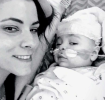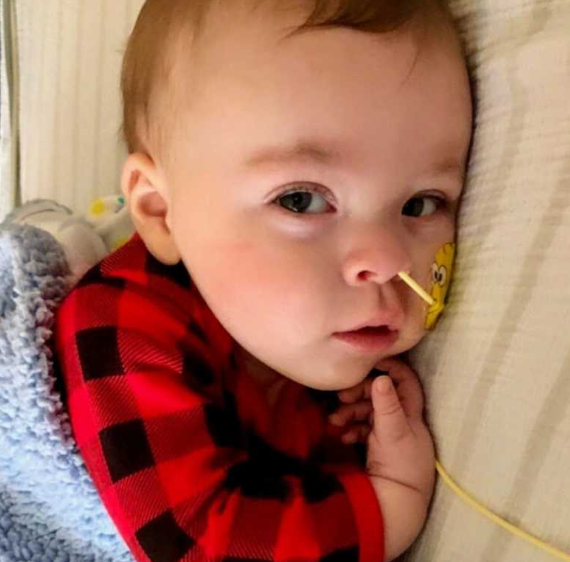
Not only during Rare Disease Month, but every day, I think of my son Joey. He was only with us for seven months, but he changed our lives in ways that are hard to put into words. I share his story to honor him, and to help others understand TBC1D24 disorder, a condition so rare that most families don’t hear its name until it becomes their world.
My pregnancy with Joey had one early scare: a bright spot on his bowel that doctors kept an eye on. After a full workup at Children’s Hospital of Philadelphia (CHOP), everything looked okay, and we were told not to worry. But later, at 36 weeks, his fetal tracking deteriorated. I was admitted for monitoring, and eventually Joey was delivered by C-section.
The moment he arrived; I just had a feeling that something wasn’t right. It wasn’t anything obvious, just a mother’s instinct I couldn’t shake.
Trying to find answers…
We took Joey home, but only for two days. He became so lethargic, wasn’t feeding that much, and just didn’t seem well. Back to the hospital we went for what became an 11-day NICU stay. At six weeks old, we started seeing more concerning signs: abnormal eye movements, hand/finger twitching, low body temperature—all early neurological red flags.
We spent weeks in and out of the hospital doing EEGs and talking with specialists, hoping someone could tell us what was going on. During our third admission, a neurologist brought up the possibility of a genetic cause. CHOP’s team moved quickly. They identified the gene to test for based on clinical pattern and confirmed a TBC1D24 mutation while Joey was still inpatient at three months old.
The team was kind, straightforward, and full of compassion. They told us they weren’t sure if Joey would make it to his first birthday. Hearing those words felt like the world had stopped.
Once we knew what we were facing, we focused on keeping Joey comfortable. We avoided procedures that wouldn’t change the outcome. His seizures were constant, even with medication. At seven months, he needed to be intubated, and even sedation couldn’t stop the seizures. Our family decided to shift to palliative-focused care to avoid unnecessary or invasive procedures.
Joey passed away at 7 months and 3 days, held and surrounded by his parents who adored him.
TBC1D24 disorder is so rare that when Joey was diagnosed, it felt like we were the only ones living with this. Connecting with another family through social media changed everything. They understood what we were going through in a way no one else could. That connection truly helped carry me through the hardest parts of grief.
Carrying Joey’s Legacy Forward
Joey is the reason I applied for the position within the Center for Epilepsy and Neurodevelopmental Disorders (ENDD). With the support of Dr. Ingo Helbig, Sarah Ruggiero LCGC, and others at CHOP, we’re working to bring awareness, research, and community to families affected by TBC1D24 and similar conditions.
I often remind other parents: we can’t control the outcome, but we can control how we show up for one another, and we can advocate for our children despite the outcome.
Joey’s life was short, but his impact continues. If his story helps even one family feel less alone, then sharing it is worth everything.
If you’d like to learn more or connect:
www.tbc1d24foundation.com
#TuesdaysWithJoJo