
Welcome to the Gene Scene! Each week, we will explore a gene from the ACMG Secondary Findings list—genes identified by the American College of Medical Genetics and Genomics as having clear, actionable health implications. These genes are included because they’re linked to serious but preventable or manageable conditions when identified early. Here, we focus on the condition that led to the gene’s inclusion on the list, providing clear, relevant information that supports your clinic. To subscribe to the Gene Scene, contact your local GSL or send a request to info@ambrygen.com.
To access the Gene Scene archives, visit our blog.
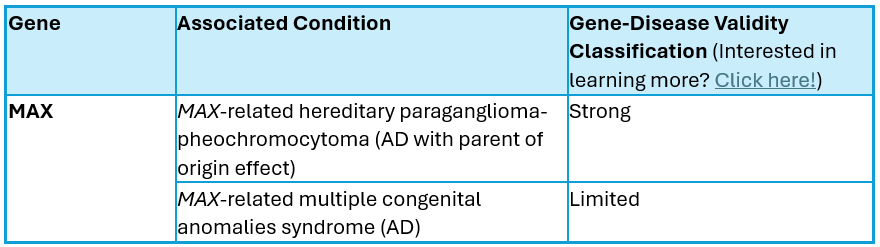
Clinical Phenotype Summary:
The MAX gene (NM_002382.3) is located on chromosome 14q23.3, encodes the protein max, and contains 5 coding exons. Pathogenic variants in this gene have been detected in individuals diagnosed with MAX-related hereditary pheochromocytoma-paraganglioma (PCC-PGL), which is inherited in an autosomal dominant fashion.
MAX-related hereditary paraganglioma-pheochromocytoma is characterized by:
• Pheochromocytoma or paraganglioma development (>50% risk when inherited paternally)
o Most frequently multifocal or bilateral catecholamine secreting adrenal PCCs
o Average age of onset between 32 and 40 years
• Additional features include:
o Renal tumors
o Neuroendocrine tumors, including pituitary adenomas and ganglioneuromas
Pathogenic variants in MAX account for approximately 1% of hereditary PCC-PGL syndromes. Loss of function has been reported as the mechanism of disease for MAX-related hereditary PCC-PGL.
Unique Considerations:
A parent-of-origin effect has been suggested based on the observation of paternal UPD of MAX in PCC tumors and preferential paternal transmission of disease, although the mechanism is not well understood.
Clinical Resources:
Clinician Management Resource for PGL/PCC Syndrome and Understanding Your Positive MAX Genetic Test Result
Citations:
• Bausch B et al. JAMA Oncol. 2017 Sep; 3(9): 1204–1212 PMID: 28384794
• Comino-Mendez I, et al. Nat. Genet. 2011 Jul;43(7):663-7 PMID: 21685915
• Burnichon N, et al. Clin. Cancer Res. 2012 May;18(10):2828-37 PMID: 22452945
• Hata S et al. Clin Pract. 2022 May 7;12(3):299-305 PMID: 35645312
• Pozza C et al. Front Endocrinol (Lausanne). 2020; 11: 234 PMID: 32508744
• Seabrook A et al. J Clin Endocrinol Metab. 2021 Mar 25;106(4):1163-1182 PMID: 33367756
Ambry Genetics Gene-Disease Validity Scheme
Each week, we explore a gene from the ACMG Secondary Findings list—genes identified by the American College of Medical Genetics and Genomics as having clear, actionable health implications. These genes are included because they’re linked to serious but preventable or manageable conditions when identified early.
To learn more about the ACMG Secondary Findings list, click here.
To read all previous Gene Scene emails, click here.