
Welcome to the Gene Scene! Each week, we will explore a gene from the ACMG Secondary Findings list—genes identified by the American College of Medical Genetics and Genomics as having clear, actionable health implications. These genes are included because they’re linked to serious but preventable or manageable conditions when identified early. Here, we focus on the condition that led to the gene’s inclusion on the list, providing clear, relevant information that supports your clinic. To subscribe to the Gene Scene, contact your local GSL or send a request to info@ambrygen.com.
To access the Gene Scene archives, visit our blog.
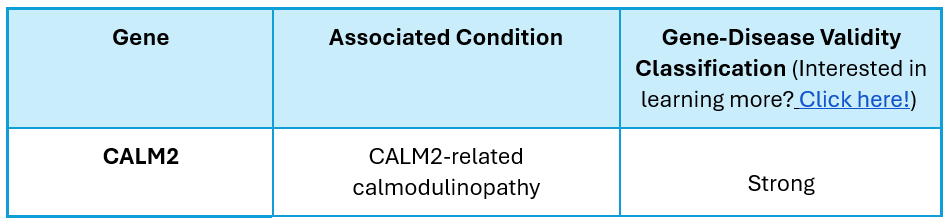
Clinical Phenotype Summary:
The CALM2 gene (NM_005184.2), which contains 6 coding exons and is located on chromosome 2p21, encodes the calmodulin-2 protein. Pathogenic variants in this gene are known to cause CALM2–related calmodulinopathy, which is an autosomal dominant condition that often occurs de novo but can be inherited.
CALM2–related calmodulinopathy is characterized by:
• Severe, life-threatening arrhythmias, particularly LQT syndrome (LQTS) and/or catecholaminergic polymorphic ventricular tachycardia (CPVT)
o These are often associated with physical exertion or emotional stress, which can lead to
Recurrent syncope
Severe arrhythmic events
Sudden cardiac death
• Congenital heart defects have been seen in a minority of cases
• Calmodulinopathy-related LQTS cases typically present with delayed ventricular repolarization and extremely prolonged corrected QT interval (QTc)
The CPVT phenotype presents as exercise- or emotion-induced polymorphic ventricular tachycardia in the presence of a structurally normal heart and normal resting ECG. Age of onset for calmodulinopathy LQTS cases may be as early as the perinatal period with sinus bradycardia, heart block, and/or prolonged QTc, while the CPVT cases typically show onset during the first decade. Pathogenic variants in CALM2 account for <1% of LQTS and CPVT cases.
Unique Considerations:
Variable expressivity and reduced penetrance have been observed.
Mechanism of disease is unclear for CALM2-related calmodulinopathy.
Clinical Resources:
Understanding Your Positive CALM2 Genetic Test Result
Ambry Knows Genes:
Scientific Posters:
• More than 95% of positive genetic results for inherited cardiomyopathies and arrhythmias have medical management implications (NSGC 2021)
EducateNext Webinars:
• Inherited Arrhythmias Webinar - Part 1 with Bettina Francesca Cuneo, MD, Teresa Caldwell Harper, MD, Robin Jenkins, Julia Wynn, MS, CGC (August 2016)
• Evaluation, Risk Stratification, and Management of Arrhythmogenic Cardiomyopathy with Arthur A.M. Wilde, MD, PhD and Cynthia A. James, ScM, PhD, CGC (March 2021)
• Medical Management for Hereditary Cardiomyopathies with John L. Jeffries, MD, MPH, FACC, FAHA, FAAP, FHFSA, FRCPE (Sept 2021)
• ACMG Secondary Findings Cardiology: Getting to the Heart of the Matter with Kelly Radtke, PhD (Sept 2024)
Citations:
• Crotti L et al. Eur Heart J, 2019 Sep;40:2964-2975. PMID: 31170290
• Tsai WC et al. Tzu Chi Med J, 2021 Apr;33:339-344. PMID: 34760628
• Hussey JW et al. Channels (Austin), 2023 Dec;17:2165278. PMID: 36629534
• Crotti L, et al. Circulation. 2013;127(9):1009-1017. PMID: 23388215
• Makita N, et al. Circ Cardiovasc Genet. 2014;7(4):466-474. PMID: 24917665
• Arnestad M, et al. Circulation. 2007;115(3):361-367. PMID: 17210839
• Tester DJ, et al. Heart Rhythm. 2005;2(5):507-517. PMID: 15840476
• Kim J, et al. J Biol Chem. 2004;279(43):45004-45012. PMID: 15316014
Ambry Genetics Gene-Disease Validity Scheme
Each week, we explore a gene from the ACMG Secondary Findings list—genes identified by the American College of Medical Genetics and Genomics as having clear, actionable health implications. These genes are included because they’re linked to serious but preventable or manageable conditions when identified early.
To learn more about the ACMG Secondary Findings list, click here
To reach all previous Gene Scene emails, click here.