
Welcome to the Gene Scene! Each week, we will explore a gene from the ACMG Secondary Findings list—genes identified by the American College of Medical Genetics and Genomics as having clear, actionable health implications. These genes are included because they’re linked to serious but preventable or manageable conditions when identified early. Here, we focus on the condition that led to the gene’s inclusion on the list, providing clear, relevant information that supports your clinic. To subscribe to the Gene Scene, contact your local GSL or send a request to info@ambrygen.com.
To access the Gene Scene archives, visit our blog.
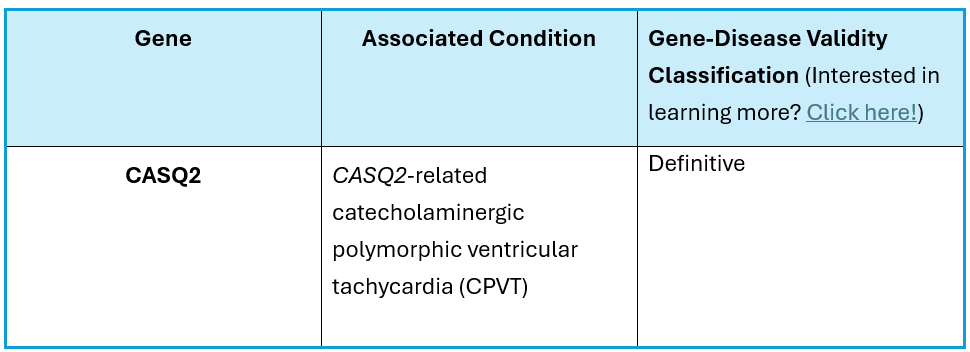
Clinical Phenotype Summary:
The CASQ2 gene (NM_001232.3), which contains 11 coding exons and is located on chromosome 1p13.1, encodes the calsequestrin-2 protein. Pathogenic variants in this gene are known to cause CASQ2-related catecholaminergic polymorphic ventricular tachycardia (CPVT), which can be inherited in an autosomal dominant or autosomal recessive fashion.
Diagnostic criteria for CPVT includes:
• Exercise- or emotion-induced bidirectional or polymorphic ventricular tachycardia in the presence of a structurally normal heart and normal resting ECG
Age of onset is typically in the first or second decade of life, and clinical manifestations such as syncope or sudden cardiac death are prompted by physical activity or emotional stress. Heterozygous CASQ2-related CPVT cases are typically less severe than autosomal recessive cases, although variable penetrance and expression have been reported.
CASQ2-related catecholaminergic polymorphic ventricular tachycardia (CPVT) is characterized by:
• Syncope
• Sudden cardiac death prompted by physical activity or emotional stress
Unique Considerations:
While biallelic loss of function has been reported as the mechanism of disease for autosomal recessive CASQ2-related CPVT, the mechanism of disease is unclear for the autosomal dominant presentation.
Clinical Resources:
Understanding Your Secondary Findings Result
Understanding Your Positive Arrhythmia Genetic Test Result
Understanding Your VUS Arrhythmia Genetic Test Result
Ambry Knows Genes:
ACMG Secondary Findings Cardiology: Getting to the Heart of the Matter with Kelly Radtke, PhD (Sept 2024)
To read more about Ambry’s research on this gene. Visit the ‘Our Research’ dropdown on our website https://www.ambrygen.com/science.
Citations:
• Circulation. Genomic and precision medicine 2022 Apr; 15(2):e003518 PMID: 35119302
• Circulation 2020 Sep; 142(10):932-947 PMID: 32693635
• Molecular genetics & genomic medicine 2019 Nov; 7(11):e949 PMID: 31482657
• Heart rhythm : the official journal of the Heart Rhythm Society 2016 May PMID: 27157848
• American journal of human genetics 2001 Dec; 69(6):1378-84 PMID: 11704930
• Circulation 2006 Sep; 114(10):1012-9 PMID: 16908766
• Ambry Genetics Gene-Disease Validity Scheme
Each week, we explore a gene from the ACMG Secondary Findings list—genes identified by the American College of Medical Genetics and Genomics as having clear, actionable health implications. These genes are included because they’re linked to serious but preventable or manageable conditions when identified early.
To learn more about the ACMG Secondary Findings list, click here
To reach all previous Gene Scene emails, click here.