
Welcome to the Gene Scene! Each week, we will explore a gene from the ACMG Secondary Findings list—genes identified by the American College of Medical Genetics and Genomics as having clear, actionable health implications. These genes are included because they’re linked to serious but preventable or manageable conditions when identified early. Here, we focus on the condition that led to the gene’s inclusion on the list, providing clear, relevant information that supports your clinic. To subscribe to the Gene Scene, contact your local GSL or send a request to info@ambrygen.com.
To access the Gene Scene archives, visit our blog.
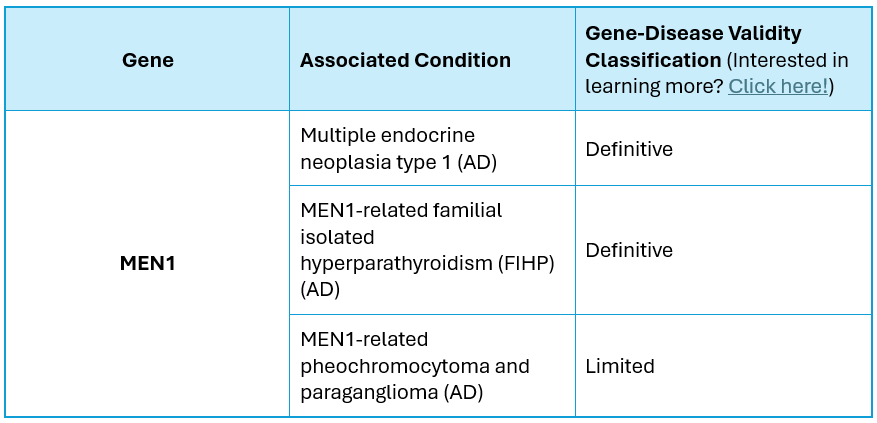
Clinical Phenotype Summary:
The MEN1 gene (NM_130799.2) is located on chromosome 11q13.1, encodes the menin protein, and contains 9 coding exons. Pathogenic variants in this gene are known to cause multiple endocrine neoplasia type 1 (MEN1) and MEN1-related familial isolated hyperparathyroidism (FIHP), which are inherited in an autosomal dominant fashion.
Multiple Endocrine Neoplasia Type 1 is characterized by:
• Parathyroid tumors (in over 90% of individuals)
• Pituitary tumors (30-50%)
• Well-differentiated endocrine tumors of the gastroenteropancreatic (GEP) tract (30-80%)
• Carcinoid tumors (5-35%)
• Adrenal adenomas (27-36%)
• Additional non-endocrine features include lipomas, meningiomas, ependymomas, leiomyomas, collagenomas, and facial angiofibromas.
Parathyroid tumors typically present with hypercalcemia or primary hyperparathyroidism (PHPT)
Pituitary tumors can cause secondary effects such as gigantism/acromegaly, hyperthyroidism, Cushing disease, oligomenorrhea/amenorrhea in females, or sexual dysfunction in males.
Endocrine tumors in the GEP tract can cause secondary effects such as anemia, diarrhea, hypoglycemia, or hyperglycemia.
MEN1-related FIHP is characterized by:
• Primary hyperparathyroidism as the sole endocrinopathy in a family
• Absence of other MEN1-associated features.
Loss of function has been reported as the mechanism of disease for MEN1 and MEN1-related FIHP.
Unique Considerations:
Penetrance in MEN1 and FIHP is high, with over 80% of individuals with a pathogenic variant exhibiting biochemical or clinical symptoms by age 50.
Clinical Resources:
Clinician Management Resource for MEN1 and Understanding Your Positive MEN1 Genetic Test Result
Citations:
• Thompson R, et al. (2021) Ther Adv Chronic Dis 12(0):20406223211035288 PMID: 34413971
• Băicoianu-Nițescu LC, et al. (2022) Diagnostics (Basel) 12(11) PMID: 36428828
• Brandi ML, et al. (2021) Endocr Rev 42(2):133-170 PMID: 33249439
• Giusti F, et al. 2005 Aug 31 [Updated 2022 Mar 10]. In: GeneReviews® [Internet]. Seattle (WA): University of Washington, Seattle; 1993-2023 PMID: 20301710
Ambry Genetics Gene-Disease Validity Scheme
Each week, we explore a gene from the ACMG Secondary Findings list—genes identified by the American College of Medical Genetics and Genomics as having clear, actionable health implications. These genes are included because they’re linked to serious but preventable or manageable conditions when identified early.
To learn more about the ACMG Secondary Findings list, click here.
To read all previous Gene Scene emails, click here.