
Welcome to the Gene Scene! Each week, we will explore a gene from the ACMG Secondary Findings list—genes identified by the American College of Medical Genetics and Genomics as having clear, actionable health implications. These genes are included because they’re linked to serious but preventable or manageable conditions when identified early. Here, we focus on the condition that led to the gene’s inclusion on the list, providing clear, relevant information that supports your clinic. To subscribe to the Gene Scene, contact your local GSL or send a request to info@ambrygen.com.
To access the Gene Scene archives, visit our blog.
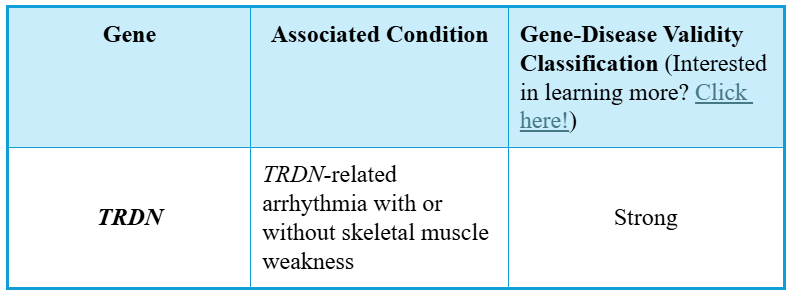
Clinical Phenotype Summary:
The TRDN gene (NM_006073.2), which contains 41 coding exons and is located on chromosome 6q22.31, encodes the triadin protein. Pathogenic variants in this gene are known to cause TRDN-related arrhythmia with or without skeletal muscle weakness (also known as triadin knockout syndrome), which is inherited in an autosomal recessive fashion.
TRDN-related arrhythmia is characterized by:
- Overlapping features of catecholaminergic ventricular tachycardia (CPVT) and long QT syndrome, which may include:
- Extensive T-wave inversions
- Bidirectional or polymorphic ventricular tachycardia
- QT prolongation (transient or persistent)
- Ventricular fibrillation
- Recurrent syncope
- Sudden cardiac arrest
- Mild skeletal myopathy or slight proximal muscle weakness, reported in some patients
Age of onset is typically in the first decade of life, and cardiac manifestations are often associated with physical exertion. Biallelic loss of function has been reported as the mechanism of disease for TRDN-related arrhythmia with or without skeletal muscle weakness.
Unique Considerations:
- Therapy options include beta-blockers, flecainide, implantable cardioverter defibrillator (ICD), and left cardiac sympathetic denervation.
- This gene is included on the ACMG secondary findings list (v3.3).
Clinical Resources:
Understanding Your Positive Exome Sequencing Test Result
Understanding Your Positive Secondary Findings Test Result
Citations:
Roux-Buisson N et al. Hum Mol Genet, 2012 Jun;21:2759-67. PMID: 22422768
Altmann HM et al. Circulation, 2015 Jun;131:2051-60. PMID: 25922419
Clemens DJ et al. Circ Genom Precis Med, 2019 Feb;12:e002419. PMID: 30649896
Ambry Genetics Gene-Disease Validity Scheme
Each week, we explore a gene from the ACMG Secondary Findings list—genes identified by the American College of Medical Genetics and Genomics as having clear, actionable health implications. These genes are included because they’re linked to serious but preventable or manageable conditions when identified early.
To learn more about the ACMG Secondary Findings list, click here.
To read all previous Gene Scene emails, click here.